THE RISE OF THRIFT STORES AND THE ROLE OF INTELLECTUAL PROPERTY RIGHTS IN RELATION TO SUSTAINABLE FASHION
Oct. 17, 2025 • RUJOOLA DAHIBAWKAR
THE RISE OF THRIFT STORES AND THE ROLE OF INTELLECTUAL PROPERTY RIGHTS IN RELATION TO SUSTAINABLE FASHION
The growing popularity of thrift stores may be the solution to the large amounts of pollution caused by fast fashion. However, opting for sustainable fashion comes with its own challenges involving infringement of Intellectual Property (IP) and counterfeiting. This article delves into the nuances of thrifting, when it may or may not lead to infringement, and how IP regimes, with a focus on trade mark law and how legal doctrines interact with the fast paced world of fashion trends, thrift stores and sustainable fashion.
- INTRODUCTION
The concept of second hand apparel is not novel - it has been around since ages, people have found a way to reuse clothes in numerous ways. In India, second hand clothes are often a means of saving resources, with clothes and jewellery often being passed down by parents to their kids or older siblings to their younger ones.
A thrift store refers to a shop that sells secondhand articles, especially clothes and is often run for charitable purposes. The concept of thrift stores mainly emerged during the 1900s in the West - with organisations such as Salvation Army and Goodwill, which started out the practice of selling donated clothes to fund social programs.
Today, thrift culture has evolved into somewhat of a style statement. It is marketed to consumers as a way of acquiring rare and vintage items, sometimes bearing luxury brands, while being sustainable and good for the environment. Thrifting clothes, jewellery, bags and even books, is more popular than ever and has become even more accessible with online thrifting platforms such as Depop, Poshmark and ThredUp, enabling netizens to easily buy second hand clothing.
In India, the idea of buying second hand clothing is often discouraged as there is stigma attached to it. However, the tides seem to be changing. Thrifting is trendy, with thrift stores, offline and online alike, being flooded with people, especially younger people such as the Gen Z, looking to buy items which are presented as unique and valuable.
Social media platforms are also doing their part, with Instagram and Facebook being popular destinations for netizens to discover small scale thrift businesses to shop from. One may even find physical shops that sell second hand clothing at popular street shopping destinations in cities like Mumbai and Delhi.
Moreover, sustainability has become extremely important in the face of global warming and climate change. Sustainable fashion practices reduce waste, discourage hyper-consumerism and. overconsumption of fast fashion.
- LEGAL CHALLENGES RELATED TO RESELLING AND UPCYCLING
With the sudden boom in online thrift stores, there are a few things to be considered - whether thrift culture is actually sustainable, the rights and limitations of the resellers and how Intellectual Property (IP) laws affect this sector.
2.1 Reseller rights
The ‘Doctrine of First Sale’ or the ‘First Sale Doctrine’ is a well-recognised legal doctrine which essentially protects the rights of the reseller. It lays down that any person who has legally purchased a trademarked product can resell it without infringement of that trademark.
According to Section 30 (3) of the Trade Marks Act, 1999, if a person lawfully acquires goods bearing a registered trade mark, the sale of those goods by that person is not infringement solely on the reasons of assignment of the registered trade mark by the registered proprietor to some other person after acquiring of those goods or the goods having been put on the market under the registered trade mark by the proprietor or with his consent.
As an exception to this rule, Section (4) clarifies that sub-section (3) shall not apply when the proprietor of the trade mark has a legitimate reason to oppose the resale of those goods when the condition of the goods has been impaired.
Thus, it can be said that the resale of goods bearing trade marks does not directly result in infringement, and thrift stores which resell such goods are not barred from doing so, unless they indulge into practices which infringe upon the trade mark of the holder.
At times, thrift stores in India sell products bearing close resemblance to the original branded product, especially luxury brands. For example, a thrift store on Instagram may sell a Miu Miu bag under INR 5000, whereas the original retails for not less than INR 2,00,000 to INR 3,00,000. The counterfeited products may be easily identified to be fake, but sometimes the resemblance is so close that they are known as ‘first copies’ or ‘first replicas’, or may even claim them to be the original second hand products and sell them for higher prices.
2.2 Upcycling of clothes and trademark infringement
Upcycling of clothes is the practice of taking a garment which is already made, then improving upon it or making a new item out of it. The goal is to make the modified item appealing to consumers. While upcycling is sustainable as it helps to extend the life of existing products, it may give rise to certain legal issues.
In the case of Chanel Inc v. Shiver + Duke LLC, a lawsuit against trade mark infringement was filed by Chanel against Shiver + Duke, a small company which sells upcycled jewellery. The reason for the dispute was jewellery that was being sold by Shiver + Duke with repurposed buttons bearing the Chanel logo. Since they were not obtained directly from Chanel with the knowledge and consent of Chanel, they were not verified as genuine by Chanel. While Chanel ultimately reached a settlement with Shiver + Duke, this case is important in terms of challenges arising out of upcycled products.
- COUNTERFEITING IN THE CONTEXT OF THE TRADE MARK ACT, 1999 AND RESALE OF SECOND HAND CLOTHING
‘Counterfeiting’ is the practice of manufacturing, selling, importing and exporting, of fake products which unauthorizedly use the trade mark of right holders. Counterfeiting by thrift stores is a common occurrence, with various stores selling counterfeit clothing and accessories such as jewellery, bags, shoes, and so on for inexpensive prices, claiming them to be genuine. It leads to trade mark infringement and passing off, among other infringements of IP Law. It may also cause confusion within the consumers regarding the authenticity and origin of a product.
Counterfeiting is defined in the form of falsifying and falsely applying trade marks as per Section 102 of the Trade Marks Act 1999, which governs the trade marks in India.
Section 102 (1) states that a person shall be deemed to falsify a trade mark who either makes that trade mark or a deceptively similar one without the authorization of the trade mark proprietor or falsifies any genuine trade mark by alteration, addition, effacement or otherwise.
Furthermore, Section 102 (2) provides that a person shall be deemed to falsely apply to goods or services a trade mark by (a) applying a trade mark or a deceptively similar mark to goods or services or any package containing goods without the assent of the proprietor of the trade mark or (b) using any package bearing a mark which is identical with or deceptively similar to the trade mark of such proprietor in order to package, fill or wrap in it, any goods which are not genuine goods of the proprietor of the trade mark.
One may be able to find counterfeit items being sold at thrift stores for much cheaper prices, and may even purchase them, either believing them to be real or just because they are being sold at inexpensive rates. This results in aiding the manufacture of such items and in turn causes harm to the original brand and the economy alike.
In a recent case involving Amazon and Beverly Hills Polo Club, which is owned by Lifestyle Equities, the Delhi High Court ordered Amazon to pay $39 Million as damages for trade mark infringement as Amazon India’s shopping website had listings of apparel with logo which was indistinguishable from the Beverly Hills Polo Club’s logo, at a fraction of the original price.
- HOW COUNTERFEITS AFFECT BRANDS
Counterfeiting is harmful to brands, as it may cause loss of revenue, harm brand reputation and may lead to brand dilution, which is the weakening of the brand’s value and distinctiveness. Luxury brands are especially vulnerable to counterfeiting, as the most easily found counterfeits are of fashion giants such as Gucci, Chanel, Louis Vuitton and Dior among others.
The ground reality is that consumers often lack awareness of the consequences of counterfeit goods, or are apathetic towards them since they get to buy products which look like a close replica of the original luxury goods.
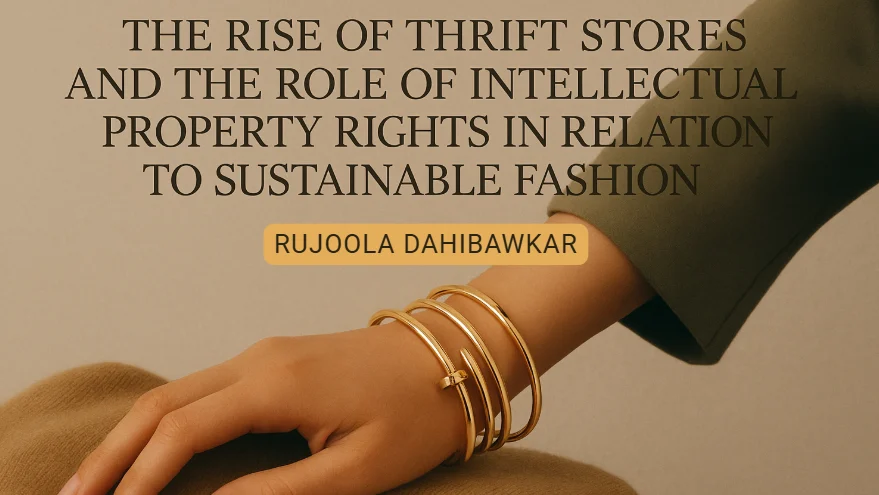
For instance, Cartier’s “Love Bracelet” which retails for about INR 7,00,000 on their official website has been the subject of counterfeiting to the extent that one would easily find almost error-free replicas at their local markets for less than INR 500 before discovering that the design was originally from Cartier. Similarly, another one of Cartier’s bracelets, the iconic “Juste un Clou Bracelet” is also a target of counterfeits, as replicas of the same are also widely available in local markets. In fact, in March 2025, Cartier won a trade mark infringement case against Goussin, a UK based jewellery business, which was selling bracelets bearing close resemblance to the original from Cartier.
Due to the design becoming so ordinary, there is a risk of reduction in sales as consumers may hesitate before purchasing the original as the distinctiveness offered by the original design has been diminished due to the high volume replicas circulating the market.
- POLICY AND REFORMS
Thrift culture is in its nascent stage in India, and it is very difficult to regulate stores which sell infringing products to the consumers by misleading them into believing they are original, rare or vintage. While Section 30 of the Trade Marks Act, 1999 is well-recognised, there are no clear laws regarding the first sale doctrine or reseller rights by the Indian Courts.
Up-cycling is also another facet of thrift culture which is yet to be recognised and regulated. Specific rules regarding what kind of alteration may lead to infringement are needed in order to protect the interests of both resellers and trade mark proprietors.
Furthermore, there is no law in place distinguishing between online and offline counterfeiting or regarding the sale of counterfeit products online through e-commerce websites or social media apps. With the growth of thrift culture in India, ambiguity surrounding IP laws in the context of online counterfeiting must be cleared.
CONCLUSION
The author believes that slowly, but steadily, the IP regime of India will evolve in order to grant protection against counterfeited goods, infringement, passing off and brand dilution.
Sustainable fashion is an integral part of the fight against environmental pollution and while it is of utmost importance to promote thrifting, reselling and upcycling, consumers need to become aware of products which infringe upon the rights of IP proprietors.
At the same time, fashion houses must be conscious about the environmental impact caused due to waste generation and huge carbon footprints. In an attempt to support sustainability and reduce their environmental impact, some fashion brands, such as Stella McCartney and Louis Vuitton, are upcycling their own products.
To conclude, it is important to support sustainable fashion practices, while being aware of the legal challenges and concerns regarding e-commerce websites and platforms selling second hand products in order to protect both the consumer and the resellers, as well as the IP proprietors.
FOOTNOTES:
- Merriam-Webster, ‘Thrift Shop’, <https://www.merriam-webster.com/dictionary/thrift%20shop> accessed 17 October 2025
- Jillian Cote, ‘Thrifting through the ages: How we’ve strayed from central values’, The Arizona State Press, (Online, February 24, 2021), <https://www.statepress.com/article/2021/03/specho-thrifting-secondhand-clothing-through-the-ages#> accessed 17 October 2025
- The Trade Marks Act, 1999
- Irene Calboli, ‘Upcycling, Sustainability, and IP: What It Means for the World of Fashion’, WIPO Magazine, (Online, July 28, 2023)
- Aditya Kalra, ‘India court orders Amazon to pay $39 million in damages in Beverly Hills Polo Club case’, Reuters, (Online, 27 February 2025) <https://www.reuters.com/business/retail-consumer/india-court-orders-amazon-pay-39-million-damages-beverly-hills-polo-club-case-2025-02-26/> accessed 17 October 2025
- Saif Khan and Prajjwal Kushwaha, ‘India: lack of court harmonisation in tackling emerging online infringement threats underscores need for further case law’, Anand and Anand, (Online, 28 June, 2025) <https://www.anandandanand.com/news-insights/india-lack-of-court-harmonisation-in-tackling-emerging-online-infringement-threats-underscores-need-for-further-case-law/> accessed 17 October, 2025
- IMAGE USED-AI GENEREATED