Sustainable Business Governance: Interconnection between Corporate, Human Resource, and Environmental Laws in responsible Growth.
Oct. 31, 2025 • Mitul Kumar Tejesvi
Sustainable Business Governance: Interconnection between Corporate, Human Resource, and Environmental Laws in responsible Growth.
Abstract
The meeting of these three legal domains- business, human resource and environmental laws is the contemporary law of environmental corporate governance. This paper discusses the interaction between these areas to achieve ethical management, employee welfare and ecological accountability. Using the precedents in the courts of law, it assesses the role played by the Indian law and international standards on the future of responsible business practices.
Introduction: The Transforming Face of Corporate Law.
The environment and the society are no longer isolated entities in business enterprise activities in the globalized economy of the twenty-first century. The legal and ethical environment in which corporate activities transpire has dramatically changed - no longer is the sole concern of profit to its shareholders, but a wider range of social, human and environmental concerns is now involved. Companies are no longer measured by their financial achievement, but in the level of responsibility in dealing with people, resources, and the planet.
Historically, the concept of business law was limited to regulatory aspects of business; the establishment of companies, contractual law and enforcement, competition law and contract dispute resolution. Nevertheless, the concept of corporate responsibility has been redefined due to globalization, the development of technology and environmental destruction. It is now mandatory due to the emergence of corporate governance norms, environmental compliance requirements, and human rights due diligence that organizations take a holistic approach, which incorporates both profitability and sustainability.
One of the greatest legal changes in the modern economy has been integration of Human Resource (HR) Law in the corporate governance matrix. The employees, who could be considered only as a factor of production, are currently considered to be the heart of innovation, productivity, and ethical reputation. The legal provisions, like the Industrial Disputes Act (1947), the Equal Remuneration Act (1976), the POSH Act (2013) etc. underline dignity, equity, and safety of workforce, i.e. the workplace is not only a place of economic production, yet it is a micro-society of social justice.
On the same note, the emergence of the environmental law has redefined the legal responsibility of corporations following the climatic change, industrial contamination, and ecological unbalance. The Environment (Protection) Act (1986), and other court case laws such as the "Polluter Pays" and the "Precautionary Principle" have compelled businesses to internalize environmental charges and act within sustainable levels. These legislations were strengthened by judicial activism like in the case of M.C. Mehta v. Vellore Citizens Welfare Forum v. Union of India. Union of India, emphasizes that the corporate citizens are no longer behind the protective veil of economic contribution.
Business, HR, and environmental law convergence, therefore, is a new legal paradigm - the one that is not merely about compliance but one that is aimed at responsible corporate citizenship. This convergence has ceased to be an option, but it is a prerequisite to the viability and sustainability of businesses in the local and international market. Investors are growing more and more careful about the value of companies in terms of their Environmental, Social and Governance (ESG) indicators, workers are insisting on a moral workplace and consumers are choosing companies that have brands which reflect sustainability and fairness.
The legal system thus is transformative in nature, making sure that there is no economic development at the cost of human well-being and the environment. The laws have become proactive as opposed to being reactive with the principles of sustainability being enforced in the very fabric of business practices. This can be traced in the efforts to have corporate social responsibility (CSR) requirement in Section 135 of the Companies Act, 2013 and increased focus on non-financial reporting by the regulators, including SEBI.
Here, the discussion that ensues analyses how the concept of sustainable governance is triadic with business, human resource, and environmental laws. It examines critical legislative measures, judicial interpretations and changing patterns of compliance that are reshaping the issue of corporate responsibility both in India and elsewhere. Eventually, it is hoped that we will show how legal synergy between these spheres can produce a better balanced, moral, and environmentally aware business environment, in which law does not serve as an instrument of punishment, but as a facilitator of responsible development.
The Business Law: The foundation of Corporate Behaviour.
Business law is used to offer the system that forms the structure through which corporations are created, contracts, competition, and adherence. The legal environment in which businesses conduct operations is influenced by laws like the Companies Act, 2013, Competition Act, 2002 and the Consumer Protection Act, 2019 in India.
Key principles include:
- Corporate Governance: Transparency, accountability and fairness in decision-making.
- Contractual Integrity: Ensuring that there are valid and enforceable contracts that safeguard the stakeholders.
- Fair Competition: Elimination of monopolistic activities that are harmful to the markets or consumers.
Case Law Insight:
Tata Consultancy Services v. Tata Electronics 1988 (20)-1024, In a business scenario, the Supreme court in the case of State of Andhra Pradesh (2004) 5 SCC 308 made it clear that the difference between tangible and intangible goods can be made out and software is goods under the Sales Tax Act and this ruling had an impact on the taxation and trade of digital commodities across the world.
This case showed that interpretation of the law develops with innovation in the business world such that the law is always dynamic to the economic realities.
Human Resource Law: Protection of Dignity and Rights of the Workforce.
The human resource of an organization constitutes the most valuable resource of the organization. The Hr law protects the rights of the employees, equality in the workplace, and equitable employment procedures. It includes such laws as:
- The Industrial Disputes Act, 1947
- The Equal Remuneration Act, 1976
- The Code on Wages, 2019
- The Sexual Harassment of Women at Workplace (Prevention, Prohibition and Redressal) Act, 2013.
The current HR legislation is concerned not only with labour welfare but inclusiveness, mental health, and work-life balance as well.
Case Law Illustration:
In Vishaka v. The Supreme Court in State of Rajasthan (1997) 6 SCC 241 established the Vishaka Guidelines that were used to stop sexual harassment in the workplace - a case that would become the 2013 Act.
This ruling highlighted the fact that the judiciary had acknowledged the right to safe working conditions as a basic right in Article 21 of the Constitution.
Corporate responsibility was redefined as well in the case, not that employers should not provide an environment that does not discriminate or abuse them, otherwise they will be liable to the law.
Environmental Law: Increasing towards Corporate Sustainability and Accountability.
With the emergence of industrialization, environmental degradation was a by-product of the growth of the economy. Environmental law thus came up as a counterchecking mechanism, which sees that business operations do not cross the ecological boundaries.
- The Environment (Protection) Act,1986
- The Air (Prevention and Control of Pollution) Act, 1981
- The Water (Prevention and Control of Pollution) Act, 1974
- The Hazardous Waste Management Rules, 2016
Judicial Perspective:
In M.C. Mehta v. The Supreme Court had introduced absolute liability of industries that are involved in hazardous operations (Union of India (Oleum Gas Leak Case, 1987 SCR (1) 819). The Court concluded that business enterprises bear an absolute and non-delegable obligation to prevent the occurrence of any harm caused by its operations - a stronger notion than the conventional liability of negligence.
Subsequent cases such as Vellore citizens welfare forum v. The Precautionary Principle and the Polluter Pays Principle were introduced in Union of India in 1996 and incorporated environmental responsibility in the business activities.
Such decisions have since informed the Indian environmental jurisprudence, and these rulings have informed corporate compliance schemes like ESG (Environmental, Social and Governance) schemes.
The Triangular Relation Business, Human, and Environmental Integration.
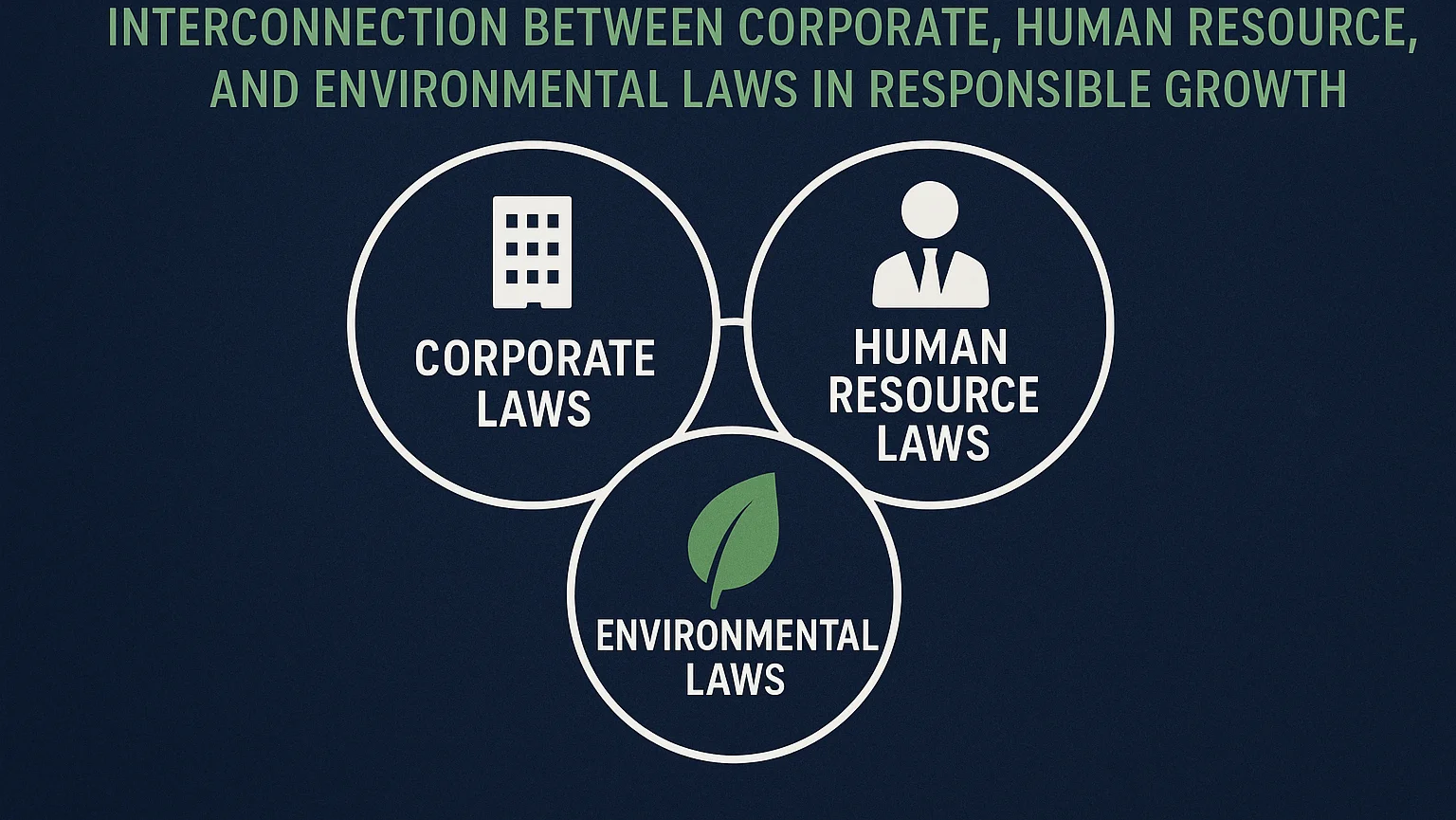
Sustainable Corporate Law is based on the overlapping between these three domains. The business success has ceased to be measured in profit margins only but rather the Triple Bottom Line (People, Planet, and Profit) are the measures of business success.
- Legal Integration: Business laws provide compliance with regulations; HR laws provide compliance with ethics of workforce; environmental laws guarantee environmental integrity.
- Corporate Governance Synergy: The introduction of sustainability committees and human rights reporting, is a modern board with the aim of adhering to the UN Guiding Principles on Business and Human Rights.
- ESG Reporting: SEBI and international standards (such as GRI and SASB) have now forced companies to report on their human resource and environmental impact.
Such a combined method turns business to be a social change agent, creating a long-term responsible culture.
Global and Indian Trends
India: The Companies Act, 2013 added a new section 135 on Corporate Social Responsibility (CSR) which conditions some companies to allocate at least 2% of the profits towards social and environmental causes.
International organizations: The OECD Guidelines on Multinational Enterprises and the Corporate Sustainability Reporting Directive by the European Union focus on transparency of human rights and the environment in a global supply chain.
Legal trend is apparent the ethical sustainability is now a business requirement not an ethical decision.
Difficulties and the Future direction.
There are still loopholes in the implementation, although the laws are strong:
Recommendations:
India has the potential to develop a global image of sustainable corporate governance through transparency and inclusiveness.
Conclusion
The modern business environment is at a crossroad - where economic aspiration has to exist with good governance ethics, environmentalism and human dignity. It is now seen as a strategic imperative as well as a legal requirement that Business Law, Human Resource Law and Environmental Law be integrated in the 21st century as a way of ensuring sustainable business practices.
- All these areas signify pillars of responsible corporate conduct:
- Business Law brings responsibility, transparency, and soundness of structure in organizational running.
- The Human Resource Law protects the rights, equity and dignity of the employees, who are the most important factor of an enterprise.
The Environmental Law serves as the conscience of an industrial growth and development whereby growth does not end up ruining the same ecosystem that supports the growth itself.
These frameworks combined form the basis of sustainable corporate governance where profitability and responsibility are not opposing forces but are complementary forces.
The progressive statutes and judicial innovation used by the Indian legal system have contributed to this integration in a decisive way. The evolution from Vishaka v. State of Rajasthan (1997) that promoted gender justice in work places to M.C. Mehta v. The case of Union of India (1987) that implemented corporate environmental liability expresses the strong dedication of the judiciary towards achieving a balance between growth and justice. The laws further indicate that the Companies Act, 2013, which focuses on Corporate Social Responsibility (CSR) in Section 135, and the SEBI (Business Responsibility and Sustainability Reporting) system are further evidences that Indian law is becoming more and more aligned to global ESG (Environmental, Social, and Governance) principles.
The will of the legislative side is high though the dilemma is on implementation and awareness. Lack of resources and knowledge of the changing legal environment has a detrimental impact on compliance on many enterprises, especially MSMEs. Corporate greenwashing, in which sustainability is more than a marketing story than a corporate commitment, is also of increasing concern. Likewise, the overloaded labour law machine does not always serve the purpose of informal and contract-based workers and there is a discrepancy between policy and practice.
Going forward, India needs to invest in the development of a unified system of compliance - the system that fosters capacity-building, technological progress, and open reporting systems. Intensifying the audit of ESG, making sustainable business models attractive by incentive, and making ethical training a part of corporate education may help reduce the discrepancy between law and corporate ethical responsibility.
The idea of Business and Human Rights, as defined in the UN Guiding Principles (UNGPs) and the emergence of Sustainable Development Goals (SDGs) at the global level have reaffirmed the fact that business cannot operate in a vacuum of social and environmental reality. The marriage between the two fields is the future of lawful governance in the single concept of responsible capitalism.
However, sustainable business governance is not simply an issue of evading legal fines in the end but redefining the moral contract between business, society and nature. The harmoniously functioning laws governing commerce, labour and environment will create an economic order that will appreciate fairness instead of exploitation, sustainability instead of short-term profit, and human good instead of uncontrollable profit making.
It is, however, not to re-invent law that the policymakers, jurists, and corporate leaders need to do, but to re-imagine what it is - a living tool of balance, compassion, and accountability. It is only with such holistic vision that businesses are able to reflect the attitude of responsible growth in which each and every decision that the business makes at the boardroom is echoed as being just at the place of work and sustainable at the environment.
REFERENCES:
- The Companies Act, No. 18 of 2013, § 135, India Code (2013), https://www.indiacode.nic.in/handle/123456789/2129.
- Companies (Corporate Social Responsibility Policy) Rules, 2014, Ministry of Corporate Affairs (India), https://www.mca.gov.in/bin/dms/getdocument?mds=ae%252FHwFZJkYfZlBsaWwMKhA%253D%253D&type=open.
- The Environment (Protection) Act, No. 29 of 1986, India Code (1986), https://www.indiacode.nic.in/handle/123456789/4310.
- The Air (Prevention and Control of Pollution) Act, No. 14 of 1981, Central Pollution Control Board (India), https://cpcb.nic.in/air-act/.
- The Water (Prevention and Control of Pollution) Act, No. 6 of 1974, Central Pollution Control Board (India), https://cpcb.nic.in/water-act/.
- The Industrial Disputes Act, No. 14 of 1947, India Code (1947), https://www.indiacode.nic.in/handle/123456789/2049.
- The Equal Remuneration Act, No. 25 of 1976, India Code (1976), https://www.indiacode.nic.in/handle/123456789/1548.
- The Code on Wages, No. 29 of 2019, India Code (2019), https://www.indiacode.nic.in/handle/123456789/15507.
- The Sexual Harassment of Women at Workplace (Prevention, Prohibition and Redressal) Act, No. 14 of 2013, India Code (2013), https://www.indiacode.nic.in/handle/123456789/2104.
- M.C. Mehta v. Union of India (Oleum Gas Leak Case), 1987 SCR (1) 819 (India), https://indiankanoon.org/doc/1486949/.
- Vishaka v. State of Rajasthan, (1997) 6 SCC 241 (India), https://indiankanoon.org/doc/1031794/.
- Vellore Citizens Welfare Forum v. Union of India, (1996) 5 SCC 647 (India), https://indiankanoon.org/doc/1934104/.
- The Competition Act, No. 12 of 2003, India Code (2002), https://www.indiacode.nic.in/handle/123456789/2006.
- The Consumer Protection Act, No. 35 of 2019, India Code (2019), https://www.indiacode.nic.in/handle/123456789/15417.
- Securities and Exchange Board of India (Business Responsibility and Sustainability Reporting) Framework, SEBI Circular No. SEBI/HO/CFD/CFD-SEC2/P/CIR/2021/562 (2021), https://www.sebi.gov.in/legal/circulars/jul-2021/business-responsibility-and-sustainability-reporting-by-listed-entities_50920.html.
- OECD Guidelines for Multinational Enterprises (2011 ed.), Organisation for Economic Co-operation and Development, https://www.oecd.org/corporate/mne/48004323.pdf.
- United Nations Guiding Principles on Business and Human Rights, U.N. Human Rights Office (2011), https://www.ohchr.org/documents/publications/guidingprinciplesbusinesshr_en.pdf.
- Global Reporting Initiative (GRI) Standards, Global Sustainability Standards Board, https://www.globalreporting.org/standards/.
- Sustainability Accounting Standards Board (SASB) Standards, International Sustainability Standards Board, https://sasb.org/standards/.
20. National Guidelines on Responsible Business Conduct (NGRBC), Ministry of Corporate Affairs (India) (2019), https://www.mca.gov.in/bin/dms/getdocument?mds=GdA3PzEeoVZghuD6AVbSRQ%253D%253D&type=open.
IMAGE USED-AI GENERATED