Huawei to Lava: The International History of the FRAND and Standard Essential Patent Jurisprudence
Oct. 31, 2025 • Rachana S V, KSLU, Bengaluru
Huawei to Lava: The International History of the FRAND and Standard Essential Patent Jurisprudence
Taking a closer look at the development of the SEP litigation in Europe, the United States, China, and India, one would be able to notice how the courts throughout the world are defining the true meaning of the term fair, reasonable, and non-discriminatory licensing in the digital age.
Background: What Are SEPs and Why FRAND is vital
All current smartphones, laptops, or other connected devices employ technologies based on technical standards, such as 4G LTE or 5G. These standards are developed through the cooperation of various companies, where each company brings its patented technology. Once a patent is made standard-essential, then no other party can adhere to the standard without utilizing the invention that is patented.
To ensure that patent holders do not abuse this authority, standard-setting organizations (SSOs) require the patent holder to license its inventions under FRAND conditions, which are Fair, Reasonable and Non-Discriminatory. However, what is fair or reasonable? And what is the outcome when an owner of a patent requests a high royalty or an implementer refuses to pay? This strain caused decades of conflicts, which resulted in historic international decisions.
Huawei v ZTE (C-170/13), 2015 : The Birth of a Global Framework
The journey begins in Europe. In 2015, the Court of Justice of the European Union (CJEU) made a landmark ruling in Huawei Technologies Co. Ltd. v ZTE Corp. It was also the initial occurrence of the apex court to set clear-cut expectations on the obligation of SEP holders and implementers prior to the injunction being granted.
What Happened
Huawei also possessed several SEPs concerning the LTE standard and was promising to license them under the terms of FRAND. ZTE, a rival telecom, was also caught violating the patented technology of Huawei without a licence. Huawei filed an injunction case in Germany. ZTE replied that the actions of Huawei were illegal and contrary to the EU competition law since the latter had not previously offered FRAND a suitable offer before suing.
The Precedent Set
The CJEU had a trade-off between patent rights and competition law. It was decided that an SEP owner who has made a FRAND commitment could not at once apply to obtain an injunction. Before suing, it must:
- Inform the alleged infringer about the infringement.
- Make a FRAND offer to license.
- Good faith negotiation in case the implementer is willing.
- In their turn, the implementer is supposed to act diligently and to counteroffer.
- In case of non-good faith negotiations between the parties, the holder of the SEP can seek an injunction.
This was to be followed by what has now been referred to as the Huawei v ZTE framework, which was the foundation of the European SEP jurisprudence.
The Impact
The case provided a roadmap that the courts in Europe, and particularly Germany and the UK, should follow to resolve the dispute concerning SEP. It established a system of procedure instead of specifying a particular royalty rate. It was focused on fair process- ensuring that both parties exploit their bargaining stage. It was the initial actual endeavor to unite patents with competition law.
Nevertheless, the ruling put in place a crucial question: What is a FRAND calculation? The question would soon be spread across the Atlantic.
TCL v Ericsson (United States) 2017–2019: The Search for a “Global Rate”
Chapter two took place in California. TCL Communication v Ericsson (2017) was the first significant American effort to determine a global FRAND royalty.
What Happened
Ericsson was an innovative telecom technology company and had thousands of SEPs in the 2G, 3G, and 4G. TCL was a Chinese handset manufacturer that was based on the technology of Ericsson, but claimed that the royalty charged was too high and not FRAND-compliant. TCL has initiated a lawsuit in which a court of law would make a decision on a reasonable FRAND rate.
The U.S. District Court had to go through titanic experience undertaking to estimate a reasonable global rate on the portfolio of Ericsson.
The Method
Judge James Selna employed a compromising style:
- Similar licences: analysis of previous partnerships that Ericsson had entered into with other parties.
- Top-down analysis: finding out the total royalty payment of a standard and dividing it into the share of Ericsson.
The court determined a particular per-unit royalty, which was less than the demand by Ericsson. However, the Federal Circuit reversed parts of the ruling on appeal, with a focus on procedural matters (including the entitlement to trial by jury) as well as a warning to other courts that establish global FRAND rates.
The Precedent Set
TCL v Ericsson revealed two important facts:
- The courts of the U.S. address FRAND as a contractual issue rather than a competition issue.
- The setting of global rates has its share of controversy- the American courts want the parties to make the decision privately or restrict the type of decision to be made to U.S. patents.
The Impact
The case contributed to the debates in the world as it showed how technical and challenging FRAND valuation can be. It also highlighted the gulf between the European procedural protection (Huawei v ZTE) and American economic analysis (TCL v Ericsson).
In 2019, the Federal Circuit reversed this, and cautioned the U.S. approach of stepping lightly before establishing international rates. In other areas, new entrants were willing to come in.
2023 OPPO v Nokia (China): China is Coming to the International Stage.
2023 – OPPO v Nokia (China): China Steps onto the Global Stage
Fast forward to 2023. In OPPO v Nokia, the Chongqing First Intermediate People’s Court in China passed a precedent decision that signaled China as a FRAND adjudicator on the global stage.
What Happened
Chinese smartphone manufacturer OPPO and Finnish telecom giant Nokia were in a battle over 4G and 5G SEPs in multiple countries. As suits were pending in Europe, India, and other places, Nokia applied to have injunctions granted in certain places. OPPO, on its part, petitioned in China with a request to have the global FRAND rates determined.
The Judgment
A step the Chinese court made was a calculated, explicit global FRAND rate on 4G and 5G SEP portfolios of Nokia.
It set:
- An increase in the rates of developed markets (such as in Europe and the U.S.),
- Reduced rates on developing economies (China and India).
The Precedent Set
A Chinese court had made claims of the power to establish a global FRAND licence, the first time. It established that:
- The Chinese courts were able to resolve the international portfolio disputes when the key parties involved were Chinese companies.
- Differentiated pricing (differentiated according to the maturity of the market) would be supported under FRAND.
This was a distinct development of the tentative attitude of TCL v Ericsson- China assumed the contrary, cementing the position that national courts could establish global rates in case of a failure in negotiations.
The Impact
The case of OPPO v Nokia changed the scenario of the world in SEP litigation. China has ceased to be a manufacturing powerhouse and become a court giant in IP licensing. This ruling made companies bring FRAND cases in the Chinese courts, where a comprehensive resolution could be made as opposed to national rulings.
Nonetheless, there are still some issues regarding the transparency, because there is a tendency to anonymize or not publish Chinese SEP judgments. Nevertheless, it reflected the pragmatic nature of China, which is inclined towards efficiency and market realism.
2024 – Ericsson v Lava (India): The Emerging Power Finds Its Voice
India had provided the most recent twist to this developing tale. The Delhi High Court in March 2024 passed the much-awaited verdict in Ericsson v Lava International, becoming the biggest award of damages on a patent in Indian history.
What Happened
Ericsson had filed a suit against Lava, a handset company based in India, which it alleged had infringed its 2G/3G SEPs. The case has been pending since 2011. Years of interim solutions and royalty mouthings under the watch of the court finally made the High Court give a decision in favour of Ericsson.
The Judgment
The Court:
- Maintained the validity and essentiality of SEPs upheld by Ericsson.
- Found Lava an unwilling licensee.
- Royalty of 1.05 percent of the net selling price of the devices of Lava.
- Damages granted of 2.44 billion (around USD 29 million).
The Precedent Set
Various principles were enforced in the judgment:
- Being ready to negotiate is a major aspect for the two sides.
- Interim royalties can be ordered by the courts to balance the interests in litigation.
- The Indian courts are free to decide global royalty rates and not only India-specific ones.
The Impact
The case made India a solid case on the SEP map. It meant that Indian courts would no longer have qualms in taking up complicated technology cases. It was based more on safeguarding the rights of SEP holders and a fair process, similar to Huawei v ZTE, but tailored, of course, to Indian realities.
It also promoted increased disclosure- data on essentiality must be disclosed by SEP holders as well as similar licences. This is an attempt by India to fit into the global standards of transparency and maintain flexibility at the same time.
The Global Picture: A Tale of Convergence and Divergence
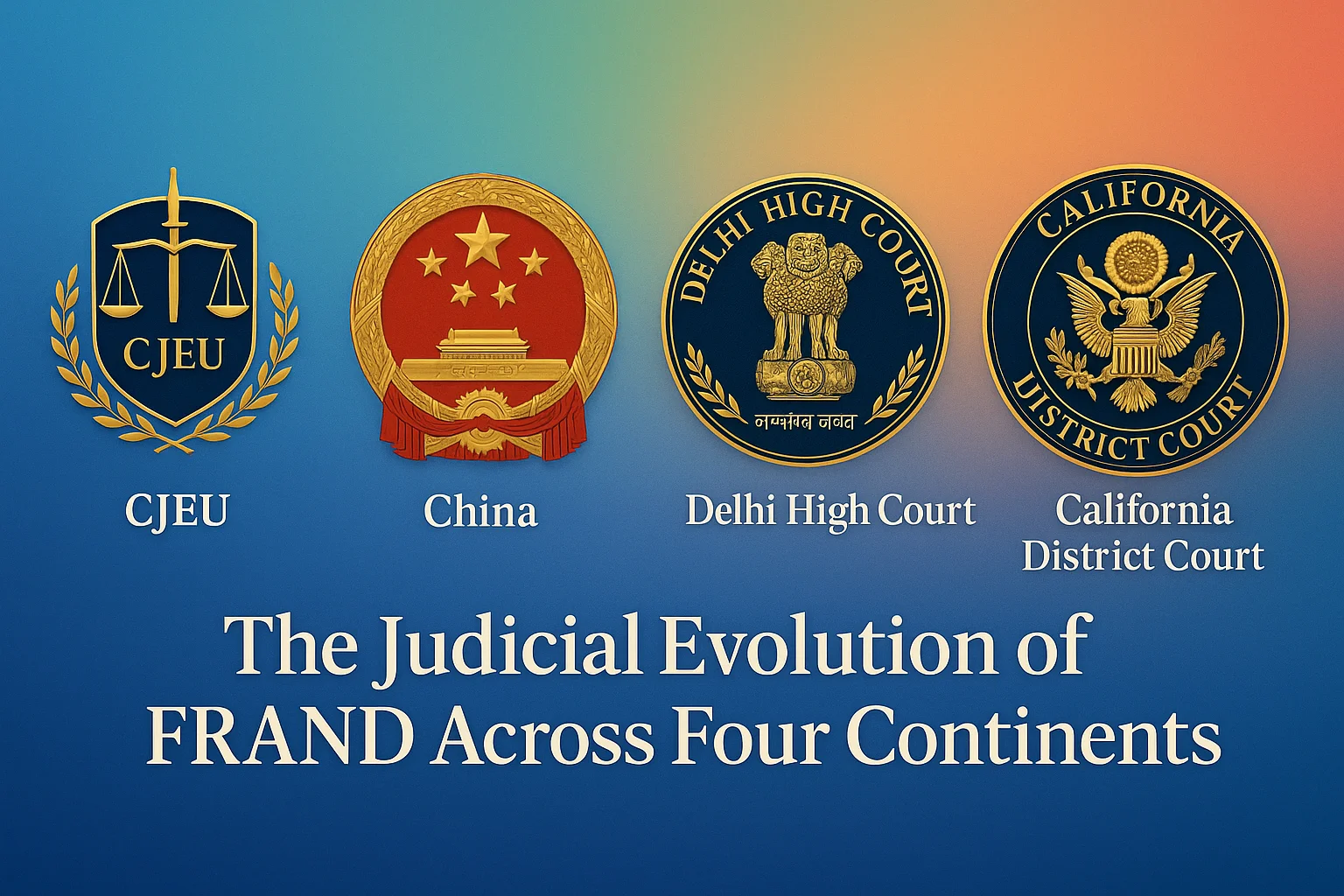
This timeline of Huawei (2015) to Lava (2024) indicates how the law on SEPs and FRAND has changed in a truly international discussion. Both of the jurisdictions learned by taking ideas borrowed elsewhere, though modifying them to local economic and legal conditions.
2015 – Huawei v. ZTE (EU):
Established the procedural good-faith framework for injunctions in Standard-Essential Patent (SEP) disputes, laying the foundation for FRAND negotiations between patent holders and implementers.
2017–2019 – TCL v. Ericsson (USA):
Tested the global valuation of FRAND terms and emphasized a contract-based method for determining fair and reasonable licensing rates.
2023 – OPPO v. Nokia (China):
Asserted China’s authority to establish international FRAND rates and introduced the concept of differential pricing based on market conditions.
2024 – Ericsson v. Lava (India):
Advanced the principles of willingness to negotiate and applied the concept of global FRAND rates within the context of emerging markets.
What the Story Tells Us
- From Procedure to Substance
Europe started by establishing the procedure roadmap in Huawei v ZTE - how SEP holders and implementers ought to act. The U.S. then changed the topic to the content: what is the proper rate? The ideas were later combined in China and India and put into practical use.
- Nation to Global Thinking.
At first, global licences were shunned by courts lest they overstep their limits. China and India have now confidently come up with global rate determinations, and this is indicative of the globalization of technology and the market.
- A Tradeoff between Innovation and Access.
In each such situation, there is a thread through it all: the need to strike a balance between the innovation stimulus (safeguarding SEP owners) and competition access (so that implementers are not unreasonably blocked). FRAND law still has this balance as its moral center.
- Transparency and Trust
In Beijing or Delhi, the courts are now requiring transparency to be shown - demonstrating necessary patents, similar licences, and records of negotiation. Lack of transparency means that there is neither FRAND fairness nor global confidence.
Conclusion: Future of FRAND -A Global Conversation
The jurisprudence of SEPs relates a remarkable story of convergence, with Huawei procedural clarity through the TCL valuation experiment, through the assertiveness of China in the world, and the pragmatic enforcement of India.
The courts that were reluctant to assess intricate telecommunication conflicts are now comfortable striking a balance between innovation, economics, and justice. However, a single system has never become perfect. Europe is procedure-centered, the U.S. is economics-centered, and China and India are scope-centered.
The world is going to 6G and IoT, which implies the necessity of cross-border collaboration. These four cases have taught that FRAND is not a rigid formula - it is a living principle, and it is developed by the discussion between nations.
The law, similar to technology as it is, is developed as jurisdictions study each other. And in that regard, Huawei v ZTE, TCL v Ericsson, OPPO v Nokia, Ericsson v Lava as a collective, are not four separate decisions- but chapters in a book- the struggle to ensure innovation is fair, reasonable, and not discriminatory to everyone.
References
- Huawei Technologies Co. Ltd. v. ZTE Corp., Case C-170/13, Judgment of 16 July 2015. https://curia.europa.eu/juris/document/document.jsf?text=&docid=165911&pageIndex=0
- European Commission Press Release: “Antitrust: EU Court Judgment in Huawei v ZTE Clarifies Rules on Standard-Essential Patents.”
https://ec.europa.eu/commission/presscorner/detail/en/IP_15_5269 - TCL Communication Technology Holdings Ltd. v. Telefonaktiebolaget LM Ericsson, Case No. 8:14-cv-00341 (C.D. Cal. Dec. 21, 2017).
https://casetext.com/case/tcl-comm-tech-holdings-ltd-v-telefonaktiebolaget-lm-ericsson - Telefonaktiebolaget LM Ericsson v. TCL Communication Technology Holdings Ltd., 943 F.3d 1360 (Fed. Cir. 2019).
https://law.justia.com/cases/federal/appellate-courts/cafc/18-1565/18-1565-2019-12-05.html - OPPO Guangdong Mobile Communications Co. Ltd. v. Nokia Technologies OY, Chongqing First Intermediate People’s Court (2023).
https://chinaiplawupdate.com/2023/07/china-court-issues-first-global-frand-rate-in-oppo-v-nokia/ - DLA Piper Insight: “China’s First Global FRAND Determination – OPPO v Nokia.”
https://www.dlapiper.com/en/insights/publications/2023/07/chinas-first-global-frand-determination-the-oppo-v-nokia-case - Telefonaktiebolaget LM Ericsson v. Lava International Ltd., CS (COMM) 434/2016, Delhi High Court Judgment (6 March 2024).
https://delhihighcourt.nic.in - Bar & Bench: “Delhi HC Awards ₹2.44 Billion in Ericsson v Lava SEP Case.”
https://www.barandbench.com/news/delhi-high-court-ericsson-v-lava-sep-case - LiveLaw: “Delhi High Court Sets FRAND Benchmark in Ericsson v Lava Case.”
https://www.livelaw.in/top-stories/delhi-high-court-ericsson-lava-frand-sep-patent-royalty-2024-252147 - WIPO Magazine: “China’s Growing Role in SEP Disputes.”
https://www.wipo.int/wipo_magazine/en/2023/china-sep-disputes.html - OECD Report: “Licensing of Standard-Essential Patents and Competition Law.” https://www.oecd.org/competition/licensing-of-standard-essential-patents-and-competition-law.htm
- Cambridge Handbook of Technical Standardization Law – Vol. II, Contreras, J.L. (Cambridge University Press, 2019).
https://www.cambridge.org/core/books/cambridge-handbook-of-technical-standardization-law/ - WIPO SCP/21/7: “Standards and Patents.”
https://www.wipo.int/edocs/mdocs/scp/en/scp_21/scp_21_7.pdf - Cover Image Credit: https://www.vecteezy.com/
- Body Image Credit: AI Generated