CASE REVIEW: Royal Challengers Sports Private Limited vs Uber India Systems Private Limited
Nov. 01, 2025 • TANNU MISHRA G. J. ADVANI LAW COLLEGE, MUMBAI
CASE TITLE
Royal Challengers Sports Private Limited vs Uber India Systems Private Limited
CITATION
CS(COMM) 345/2025
COURT
Delhi High Court
BENCH
Justice Saurabh Banerjee
DATE OF JUDGEMENT
05th May, 2025
RELEVANT STATUTES
- Code of Civil Procedure, 1908
- Trademarks Act, 1999
- Constitution of India, 1950
INTRODUCTION
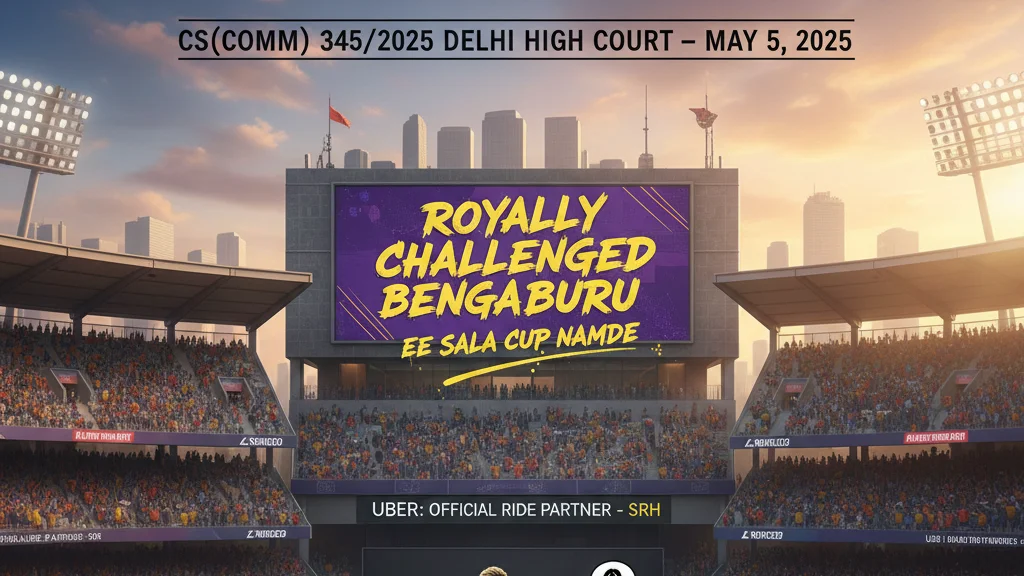
Royal Challengers Sports Pvt. Ltd. v. Uber India Systems Pvt. Ltd. is a Delhi High Court case that was filed due to an advertisement of Uber during the IPL 2025 season. This ad was about featuring Australian cricketer Travis Head, referring to the opposing team, Sunrisers Hyderabad, as the Hyderabaddies, and portraying Royal Challengers Bengaluru (RCB) as the Royally Challenged Bengaluru, along with the RCB fan slogan written in English, Ee Sala Cup Namde. RCB, which stated that it was infringing, diluting, and disparaging its registered trademark and goodwill, requested a temporary injunction to prevent Uber from airing the advertisement. Uber justified the campaign as a joke in sporting spirit and advocated for commercial-free speech. The case clarified what trademark rights are and elaborated on what actions actually cause the infringement or disparagement of trademarks.
BRIEF FACTS
The case began with a lawsuit filed against Uber India Systems Pvt. Ltd., its parent company, and the cricketer Travis Head by the owner of the IPL team Royal Challengers Bengaluru (RCB) and registered proprietor of the RCB trademark being Royal Challengers Sports Pvt. Ltd. The case arose because of an advertisement that Uber published on its social media on April 2025, which included Travis Head, a player of Sunrisers Hyderabad (SRH). In the advertisement, Head spray-painted the words "Royally Challenged Bengaluru" on the name of RCB and the popular RCB fan slogan of Ee Sala Cup Namde in the background, and flees on an Uber Moto bike. The plaintiff claimed that this constituted trademark infringement, dilution, and disparagement, since it seemingly had negative impacts for their team and harmed their goodwill too, particularly at the time of the IPL 2025 season, which was in progress. However, the defendants justified the advertisement by claiming that it was nothing but a parody and a pun on the culture of cricket rivalry, which is safeguarded by the freedom of speech provision of the Indian Constitution.
ISSUES INVOLVED
- Does the use of the phrase “Royally Challenged Bengaluru” in the impugned advertisement amount to infringement and dilution of the registered trademark “Royal Challengers Bengaluru”?
- Did the depiction of RCB’s name, along with the use of its fan slogan “Ee Sala Cup Namde” in the advertisement, constitute disparagement, ridicule, or tarnishment of the goodwill associated with the RCB team?
- Is the advertisement crossing the permissible limits of comparative advertising and parody, or is it protected as light-hearted banter and fair use within the cultural context of cricket rivalry?
- Does Uber’s right to commercial free speech and creative expression in advertising outweigh RCB’s claim of trademark protection and reputation, considering the reasonable restrictions under Article 19(2)?
ARGUMENTS
PLAINTIFF
The counsel for Plaintiff, Royal Challengers Sports Pvt. Ltd., Ms. Shwetashree Majumdar, argued that the advertisement created by the defendants involving a cricketer, Travis Head, constituted infringement and dilution of trademark, as well as disparagement, of the popular Royal Challengers Bengaluru (RCB) brand. The counsel argued that the display of the phrase "Royally Challenged Bengaluru" on a stadium banner and the use of the RCB fans' slogan "Ee Sala Cup Namde" in the background ridiculed and tainted the team's identity, which was damaging as it invalidated its goodwill and emotional attachment to supporters. Ms. Majumdar stressed that this was not a comparative advertisement but an outright effort to attack RCB in the IPL season, particularly when Uber was depicted as the Official Ride Partner of the Hyderabad team, which was an advertisement made by the competitor team (SRH). Basing on the previous cases in which courts have prohibited derogatory depictions of the trademarks in the films and advertisements, such as Hamdard National Foundation v. Hussain Dalal (2013) where the Delhi High Court restrained the film Yeh Jawaani Hai Deewani for calling “Rooh Afza” bekaar, and ICICI Bank Ltd. v. Ashok Thakeria (2013) where the Court injuncted the film Grand Masti for showing a robbery in a deceptively similar “IBIBI Bank,” the plaintiff argued that the derogated association was established by the impugned advertisement, causing irreparable damage to the reputation of RCB, and thus, the advertisement attracts square liability under Section 29(4) of the Trade Marks Act, 1999, which justifies seeking an injunction.
DEFENDANT
The counsel of the defendants, Uber India Systems Pvt. Ltd., and its parent company, Mr Sai Krishna Rajgopal, argued that the suit was an unwarranted move by the plaintiff, and that the allegedly offending advertisement was not less than a harmless parody, which is an Indian cultural aspect of cricket. The counsel claimed that the slogan Royally Challenged Bengaluru was a pun, that is, Bengaluru was to be challenged in the following game against Hyderabad and not an offensive remark against RCB’s reputation. The learned counsel highlighted that the intention of the advertisement was about having an efficient and reliable ride-hailing service, which is depicted by Uber Moto arriving to rescue Travis Head in three minutes. According to the defendant, the ad did not disparage or offer any comparison of the quality of the team or the trademark of RCB, and therefore, it did not attribute any negative qualities to them. According to the defendants, parody and humor fall under the right of expression, and that commercial free speech, as outlined in Article 19(1)(a) of the Constitution, was utilized to protect such artistic advertising. They also pointed out that the use of the RCB slogan, the Ee Sala Cup Namde, was neither purposeful nor derogatory, and the remarks of the people on the advertisement showed that most people considered the advertisement to be funny. The counsel for the defendants in their submission relied on Tata Sons Pvt. Ltd. v. Puro Wellness Pvt. Ltd. (2023) in which the Delhi High Court clarified that advertisements should be evaluated as a whole, in the context of disparagement, and Laugh It Off Promotions CC v South African Breweries (2005) where the South African Constitutional Court affirmed protection of parody trademarks (e.g., Black Label - Black Labour) as humour, arguing that parody alongwith nominative use does not amounts to infringement or disparagement. Hence, the defendant's counsel contended that infringement, disparagement, and irreparable damages were not inflicted on the plaintiff, and the balance of convenience was in favor of safeguarding their right to free expression.
JUDGEMENT
While adjudicating this case, the Delhi High Court considered an extensive examination of the plaintiff’s request to be granted an interim injunction by applying the two-prong test, that is, (i) whether the impugned advertisement was disparagement per se and (ii) whether the impugned advertisement was infringement as per Section 29(4) of the Trade Marks Act, 1999. The Court further explained that disparagement is only established by the fact that there exists an apparent element of ridicule, falsity, or denigration which is knowingly and willfully done with the intent of causing harm, and such was not the case in this situation. Based on Pepsi Co. Inc. v. Hindustan Coca Cola Ltd. (2003), a case which stated that disparagement could be ascertained by intent, manner, and storyline of an advertisement, the Court adjudicated that there was no negative intent in Uber’s advertisement. On the same note, the Madras High Court, in Gillette India Ltd v. Reckitt Benckiser (2018), had stated that disparagement must be clearly ridiculed or denounced, and that was not what happened in this case. Upon looking at the advertisement as a whole, the Court decided that it was a humorous advertisement that consisted of cricketing banter, which did not add to the reputation or goodwill of the RCB trademark. The term Royally Challenged and the slogan of the fans, Ee Sala Cup Namde, were viewed as being contextual in nature, and in the spirit of cricketing rivalry, but not derogation or dilution of any kind. The Court also decided, based on ITC Ltd. v. Philip Morris (2010), that Section 29(4) has a greater burden of proving the dilution claim, that it must be shown that there is unfair advantage or detriment, which the Court did not find in this case. Another point raised by the Court, referring to Tata Press Ltd. v. MTNL (1995), is that commercial speech, such as advertising with joking or exaggerated content, is under the protection of Article 19(1)(a) of the Constitution, which has a reasonable restriction. Lastly, acknowledging the caution given by the Supreme Court in Bloomberg Television v. Zee Entertainment (2025), the Court asserted that prolonged litigation harms free expression, denied the plaintiff the temporary injunction because it found no prima facie case of infringement or disparagement, no irreparable harm, and that the balance of convenience favored the defendants. The ad was hence construed as lighthearted sporting humor.
RATIO DECIDENDI
The Delhi High Court justified its judgment by giving the ratio decidendi that for an advertisement to constitute disparagement per se, it must include the elements of ridicule, falsity, or denigration that are accompanied by the intent to harm, and this was not available in the impugned Uber campaign. The Court reasoned that an advertisement should be evaluated as a whole, and not frame-by-frame basis, to find disparagement. Based on this reason, the Court determined that the words Royally Challenged and the fan slogan Ee Sala Cup Namde were a contextual mention in the spirit of sporting rivalry, which does not directly disparage the reputation of the RCB trademark. Moreover, infringement in section 29(4) of the Trade Marks Act demands showing the use without due cause that unfairly exploits or is detrimental to the distinctive character of the mark, which was not seen in the present case. To support the argument of commercial speech, being humorous or exaggerated advertising, it is safeguarded by Article 19(1)(a). The Court provided the reasoning behind its judgment by stating that the advertisement in question was a kind of admissible creative speech and not an admissible disparagement.
FINAL DECISION
The Delhi High Court rejected RCB’s prayer for a temporary injunction. Justice Saurabh Banerjee opined that the ad, when looked at as a whole, was not considered to constitute disparagement or infringement of Section 29(4) of the Trade Marks Act, 1999. As pointed out by the Court, the intent, the manner, and the message of the advertisement focused on demonstrating the efficiency of Uber's service, but not the devaluation of RCB’s trademark. The term Royally Challenged Bengaluru was found to be a good-natured, humorous reference in the world of cricket rivalry and was not disparaging or actionable. The use of the slogan Ee Sala Cup Namde in the advertisement was similarly found to be a good-natured, humorous allusion in the situation, not actionable disparagement. Thus, the Court decided that there was no prima facie case, irreparable harm, and a balance of convenience in favor of RCB and that Uber could not be restrained from carrying on with the advertisement.
IMPACTS OF THE JUDGMENT
- Trademark Law and Sports Rivalry: The decision makes clear that in cases where an advertisement makes humorous references to a sports team, the advertisement is within the bounds of the permissible commercial free speech. This precedes a case of a trade-off between protecting trademarks and the cultural reality of sporting banter.
- Upheld Commercial Free Speech: The Court upheld commercial free speech by reaffirming that an advertisement was a valid form of speech under Article 19(1)(a), especially when it is parodical, humorous, or exaggerated without the distortion of the truth. This enhances the creative marketing campaigns within India.
- Increased Threshold in Disparagement Claims: The court highlights the fact that offense or hypersensitivity alone by the trademark owners is not enough. To be successful in disparagement claims, plaintiffs have to prove obvious aspects of falsehood, ridicule, or denigration.
- Dilution Doctrine Revised: The Court once again stated that Section 29(4) depends highly on the proofs. Similarity or parody of a famous mark by mere resemblance, without any unfair advantage or harm, will not necessarily constitute dilution.
This is a landmark judgment because it establishes a balance between intellectual property rights and the freedom of creativity in advertising, particularly in the highly emotive field of sports. It safeguards the cultural room of humor whilst warning brand holders that they should not push the trademark legislation to the extreme to curb or stop humorous expressions.