CASE REVIEW: Bhaktivedanta Book Trust, India vs Bhagavatam. In
Nov. 15, 2025 • TANNU MISHRA G. J. ADVANI LAW COLLEGE, MUMBAI
CASE TITLE
Bhaktivedanta Book Trust, India vs Bhagavatam. In
CITATION
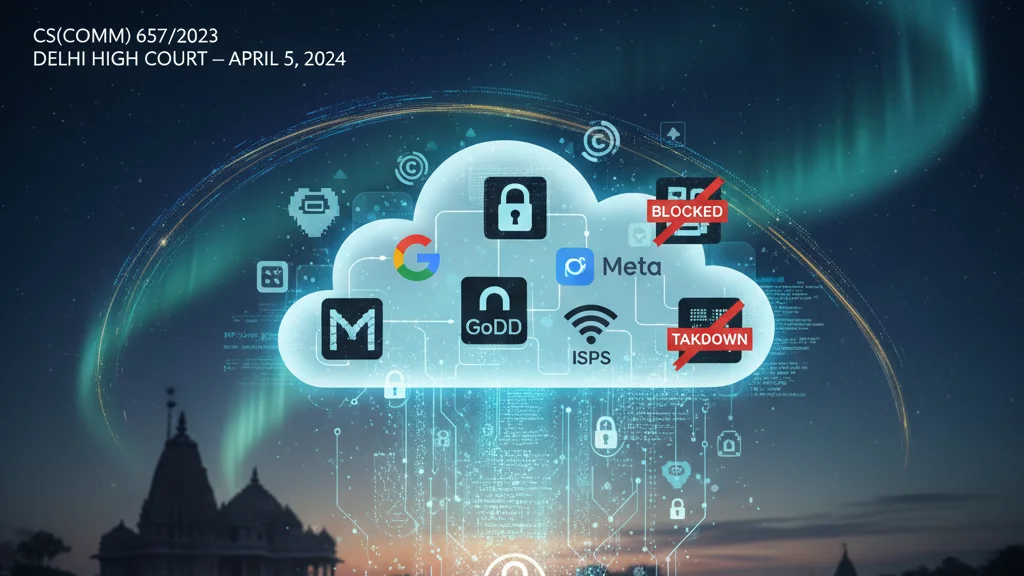
CS(COMM) 657/2023
COURT
Delhi High Court
BENCH
Justice Pratima Singh
DATE OF JUDGEMENT
05th April 2024
RELEVANT STATUTES
- Copyright Act, 1957
- Code of Civil Procedure, 1908
- Commercial Courts Act, 2015
INTRODUCTION
The Bhaktivedanta Book Trust, India v. Bhagavatam.In is a Delhi High Court case related to copyright violation of the literary works of A.C. Bhaktivedanta Swami Prabhupada, the founder of the ISKCON. The Bhaktivedanta Book Trust, which owns the copyrights in his translations, commentaries, and teachings, claimed that several websites, mobile applications, and social media apps were replicating and publishing his work without permission. Using the Copyright Act, 1957, and procedural clauses of the Code of Civil Procedure, 1908 and Commercial Courts Act, Justice Prathiba M. Singh delivered an ex parte ad interim injunction to restrain the defendants against future acts of infringement and also ordered intermediaries like Google, Meta, GoDaddy, ISPs, and government bodies (DoT and MeitY) to block access to the infringing content. This judgement highlights the difference between the scriptures under the public domain and the commentaries and interpretations of the scriptures under the copyright of writing by spiritual teachers.
BRIEF FACTS
The Plaintiff, a religious organization founded by His Divine Grace A.C. Bhaktivedanta Swami Prabhupada, a well-known spiritual scholar and author of numerous religious texts, including the "Srimad Bhagavatam," was established as a trust by the author. The International Society for Krishna Consciousness (ISKCON) was founded by him as well. The Plaintiff distributed his works to the public via religious institutions and the internet, and they had multiple copyright registrations. The plaintiff received royalties from the sale and use of some of these copyrighted works in the commercial market. The plaintiff claimed that a number of defendants were illegally reproducing their copyrighted works on different online platforms, including websites, mobile applications, and Instagram accounts. On the Google Play Store, one of the defendants even hosted a mobile application. The Plaintiff claimed that the Defendants' false citation of the Plaintiff as the source demonstrated their dishonesty and that they had no license to reproduce their copyrighted works. The plaintiff further asserted that the money it received from the sale and distribution of its copyrighted content was used for charitable purposes. It contended that since the defendants lacked the necessary licenses or rights, their reproduction of the concerned works was unlawful and ought to be stopped.
ISSUES INVOLVED
- Whether Bhaktivedanta Book Trust holds valid copyright of the works of A.C. Bhaktivedanta Swami Prabhupada, and whether his translations, commentaries, and purports are, under the Copyright Act, 1957, regarded as original literary work.
- Whether scriptures, such as the Bhagavad Gita and Bhagavatam, which are in the public domain, can be reproduced freely, and to what extent the works derived (translations, interpretations, and commentaries) themselves are subject to copyright.
- Whether the websites, applications, and social media accounts of the defendants reproduced and transmitted the works of the Plaintiff without authorization, thereby committing copyright infringement.
- Whether intermediaries, including Google, Meta, GoDaddy, ISPs, and government bodies (DoT, MeitY) be instructed to block, suspend, or otherwise remove infringing content.
ARGUMENTS
PLAINTIFF
Bhaktivedanta Book Trust argued that it is the legitimate holder of copyright to the works of A.C. Bhaktivedanta Swami Prabhupada, who assigned all his rights to the Trust during his lifetime. Although the Plaintiff admitted that scriptures like the Bhagavad Gita, Bhagavatam are in the public domain, he has pointed out that translations, commentaries, purports, introductions, and prefaces are original literary works that should be subjected to protection under the Copyright Act, 1957. The Trust claimed that the websites, mobile apps, and Instagram accounts owned by the defendants had copied these works verbatim, including the name and logos of the Trust, therefore leading to deception, loss of economic value, and dilution of its rights. It emphasized that the royalties from such works were used in its charitable and religious work, and blanket piracy would be irreparable. To support their argument, the Plaintiff cited Bhaktivedanta Book Trust v. Thomson Press (India) Ltd. judgement, which upheld its copyright, and in Chandra Kishore Chaurasia v. R.A. Perfumery Works Pvt. Ltd., to justify the exemption from the pre-litigation mediation.
DEFENDANT
The defendants responded that the underlying scriptures are ancient texts in the public domain and can be reproduced with free will, and that no copyright claims can exist in the shlokas. They argued that they were sharing the texts for devotional and educational purposes and not to gain profits, and that they had responded instantly to requests to take down the texts as a testament to acting in good faith. Bhagavatam. In went as far as to apologize that the uploaded content had been uploaded at the request of the devotees and was removed immediately once they were notified. Implicitly, the defendants sought to invoke the fair dealing exceptions of Section 52 of the Copyright Act, as they used the material not commercially, but in a religious manner. They also emphasized that there was no bad intent and, therefore, any form of infringement was unintentional rather than deliberate.
JUDGEMENT
Justice Prathiba M. Singh of the Delhi High Court ruled that although the scriptures, including the Bhagavad Gita and the Bhagavatam, are under the public domain and can thus be reproduced freely, the translations, commentaries, purports, introductions, and interpretations of the scriptures as authored by A.C. Bhaktivedanta Swami Prabhupada is an original literary work which falls under the Copyright Act, 1957. The Court has observed that the websites, mobile applications, and social media accounts of the defendants had reproduced these works word-for-word, including prefaces and covers, and thus violated the copyright of the Plaintiff. The Court emphasized that unchecked piracy would damage the rights of the Plaintiff irreparably because the Trust depends on such works to get royalties to support its charitable and spiritual activities.
While adjudicating this case, the Court relied on the precedent of Bhaktivedanta Book Trust v. Thomson Press (India) Ltd, wherein the Bombay High Court had upheld the trust’s copyright in Srila Prabhupada’s writings. It also referred to Chandra Kishore Chaurasia v. R.A. Perfumery Works Pvt. Ltd. to justify the exemption of the pre-litigation mediation under Section 12A of the Commercial Courts Act, 2015. The Court found a strong prima facie case, a balance of convenience in favour of the Plaintiff, and irreparable injury without relief. It granted an ex parte ad interim injunction under Order XXXIX, Rules 1 and 2 CPC, restraining the concerned defendants from reproducing or disseminating the works. Further, the intermediaries, such as Google, Meta, GoDaddy, ISPs, and governmental agencies, such as the Department of Telecommunications (DoT) and Ministry of Electronics and Information Technology (MeitY), were ordered to block or delete infringing content and provide information regarding the violators.
RATIO DECIDENDI
The Delhi High Court decided that, though the Bhagavad Gita and Bhagavatam are ancient texts in the public domain and could be reproduced freely, the translation, comments, purport, introductions, and interpretations written by A.C. Bhaktivedanta swami Prabhupada were original literary works and were to be granted copyright protection in accordance with the Copyright Act, 1957. The Court gave the rationale for its judgment on the fact that the verbatim reproduction of these works by the defendants on the websites, mobile applications, and social media platforms constituted plain infringement, as they did not merely reproduce the bare shlokas but the original expression of the Plaintiff. The court upheld that the Trust was the owner of the rights, and it was found that the Plaintiff had a prima facie case, and a balance of convenience. An ex parte ad interim injunction was therefore issued against further dissemination and to block or remove the infringing content.
FINAL DECISION
The final decision of the Delhi High Court in this case was that the Bhagavad Gita and the Bhagavatam are in the public domain, but their translations, commentaries, and purports, including those of A.C. Bhaktivedanta Swami Prabhupada, were original literary works and would be protectable under the Copyright Act, 1957. The Court discovered that the defendants had reproduced Swami Prabhupada’s works word-for-word and therefore granted an ex parte ad interim injunction to prohibit any further distribution. Google, Meta, GoDaddy, ISPs, DoT, and MeitY were instructed to block or take down the infringed content and disclose details of the infringers.
IMPACTS OF THE JUDGMENT
This decision reinforces the principle that, although the sacred texts themselves are free to be utilized by the public, any other works that are based on those sacred texts, including an interpretation or commentary, are under copyright protection. It empowers religious and cultural faith in defending their intellectual property, especially in the digital arena, where piracy is a significant issue. The decision to hold intermediaries liable and directing proactive blocking and takedown actions also indicated that the Court would be playing an active role in enforcing copyright protections in India. The case, therefore, establishes a valuable precedent towards balancing respect for publicly available scripture along with protecting the creative efforts of contemporary spiritual authors.
IMAGE AI GENERATED